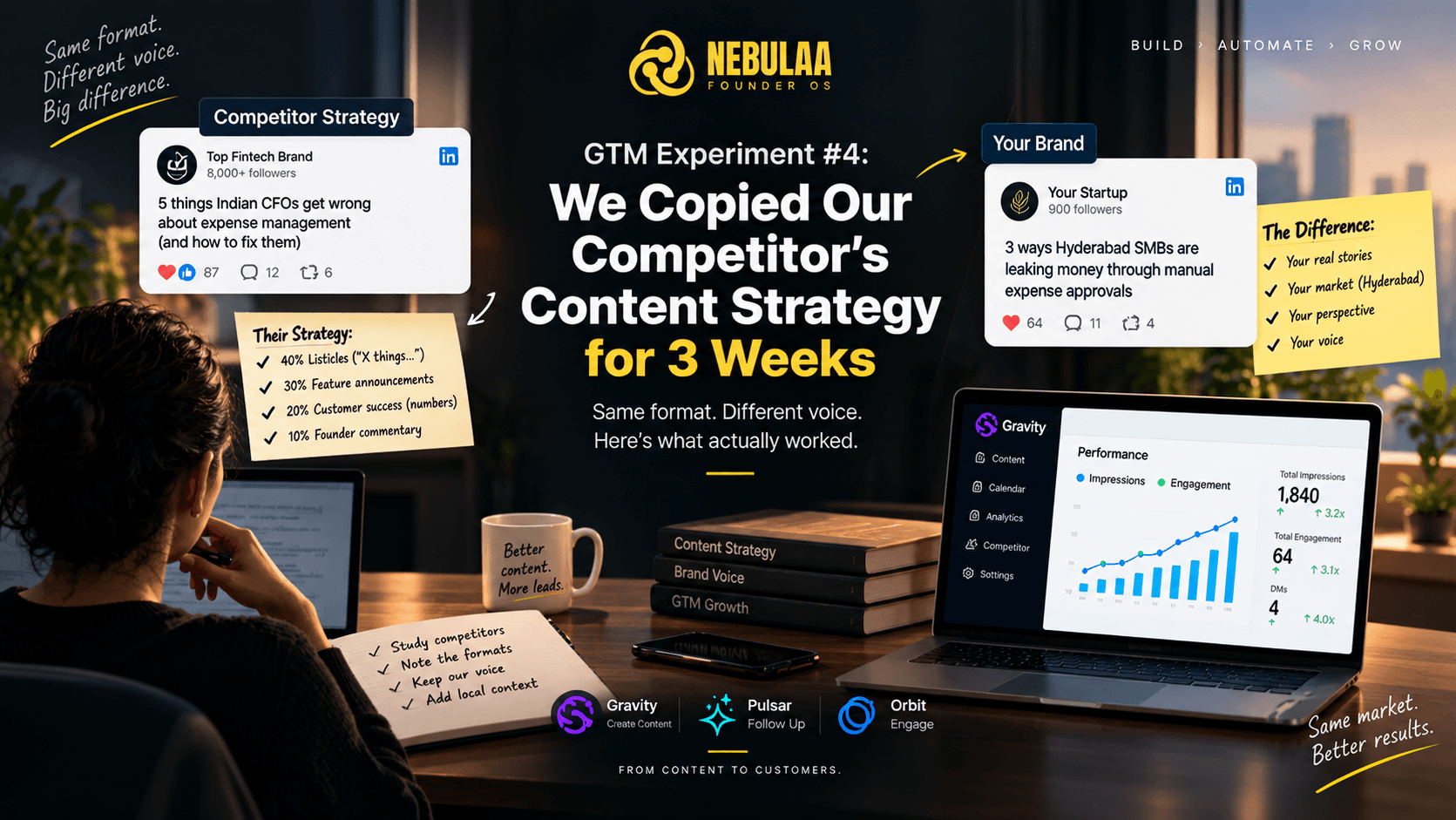
GTM Experiment #4: We Copied Our Competitor's Content Strategy for 3 Weeks
GTM Experiment #4: We Copied Our Competitor's Content Strategy for 3 Weeks
This started as a joke in a team meeting. "Their LinkedIn is doing well. Should we just do what they're doing?"
We weren't joking for long. Deepika runs a fintech startup in Hyderabad — expense management software for Indian SMBs. Her main competitor had nearly 8,000 LinkedIn followers, consistently got 50–100 likes per post, and seemed to dominate the conversation in their category. Deepika had 900 followers and posts that averaged 12 likes.
She spent 2 hours analysing the competitor's last 60 posts. Then she instructed Gravity to mirror that content strategy exactly for 3 weeks. Here's what happened.
The Competitor's Strategy (Reverse Engineered)
After analysing 60 posts across 8 weeks, the competitor's formula was clear:
40% posts: "X things Indian CFOs get wrong" — listicle format, slightly provocative headlines
30% posts: Feature announcements dressed up as insight ("Why real-time expense visibility matters in Q4")
20% posts: Customer success numbers (always round, always impressive)
10% posts: Founder commentary on GST/compliance news
Average post length: 180–220 words. Posting frequency: 5 days per week. Always ended with a question to drive comments.
Gravity was briefed on this exact structure and tasked with replicating the format and topic cadence for Deepika's brand.
Week 1: Matching the Format
Gravity produced 5 posts using the competitor's listicle-heavy format. Topics adapted for Deepika's angle (SMB-focused, not enterprise).
Immediate improvement. The format was clearly working better than what Deepika had been doing.
Week 2: The Voice Problem Emerges
Week 2 started showing something unexpected. Engagement was up, but the replies in comments felt off. People were engaging with the format, but when they'd visit Deepika's profile or check previous posts, there was a tone mismatch. The listicle-heavy, authoritative voice didn't match the more conversational, founder-led content she'd posted before.
Three people explicitly commented things like "this doesn't sound like your usual posts" or "different vibe this week."
One qualified lead who had been watching her content sent a DM asking if she'd changed her social media team.
Impressions kept climbing. But the conversion signal — DMs and profile visits — started declining. The audience was entertained but less connected.
Week 3: Hybrid Approach
In week 3, Deepika and Gravity found a middle ground. Take the competitor's format structure (listicles, data, timely topics) but infuse her own voice, her own specific stories, and her own Hyderabad-based SMB examples.
A post titled "3 ways Hyderabad SMBs are leaking money through manual expense approvals" — her voice, her market, competitor format — became her highest-performing post ever. 1,840 impressions. 64 likes. 11 comments. And 4 DMs.
The Big Lesson
Copying a competitor's content strategy is actually a useful exercise — for understanding what format and cadence works in your category. But the mistake is copying the voice too.
Your competitors have built an audience. That audience trusts their specific perspective and personality. If you replicate the structure but borrow their voice, you're not attracting your audience — you're building a pale imitation of theirs.
The right move: steal the format, keep the voice.
Gravity's competitor tracking feature is designed for exactly this — it monitors what's working in your category and uses those signals to generate content that fits your brand, not your competitor's.
Conclusion
Deepika ended the 3-week experiment with 75 new followers, 2 demo conversations, and a much better understanding of what format her market responds to. She also learned that the thing that made her content convert wasn't format — it was specificity. Her city. Her customers. Her stories.
Key Takeaways
Your competitor's content format is worth studying and adapting
Copying their voice creates brand confusion and hurts conversion
Specificity (city, industry, real customer stories) drives DMs more than generic engagement
The best strategy: competitor's format + your brand voice + your market's context
Want Gravity to track your competitors and use their signals to improve your own content? Start your free 7-day trial →
Get GTM playbooks that actually work
One email a week. Actionable tips for founders building in India. No fluff, no spam — ever.
Unsubscribe anytime.
Ready to automate your GTM?
100 free credits. No card required. Setup in 24 hours.
Start your free trial →